 how-to
How to Avoid Unnecessary Car Repairs: 7 Steps
Last Updated: October 23, 2026
Quick Summary
To avoid unnecessary car repairs, follow the maintenance schedule in your owner's manual instead of the service menu a shop hands you at the counter. Check every recommended service against that schedule, ask what test or symptom led to the diagnosis, and get the recommendation in writing before you approve any work.
- Photograph the maintenance schedule in your owner's manual so you can check it against any repair estimate.
- A written diagnosis should name the symptom, the test performed, the result, and the recommended repair.
- A diagnostic trouble code tells you which system reported a fault, not which part failed.
- Sort every recommendation into safety-critical, reliability, comfort, or cosmetic, and fix safety items now.
- Check your VIN for safety recalls before approving any repair, since a recall fix may be free.
Table of Contents
- Start With Your Owner's Manual, Not the Shop's Upsell Menu
- How to Read a Car Repair Estimate Line by Line
- Questions to Ask a Mechanic Before Repair Work Begins
- How to Get a Second Opinion on Car Repairs Without Wasting Time
- Prioritize Repairs by Safety and Urgency to Avoid Unnecessary Car Repairs
- Driving Habits and Routine Checks That Prevent Costly Repairs
- Spot the Warning Signs of Over-Maintenance Before You Approve Work
- Conclusion
- Frequently Asked Questions
Start With Your Owner's Manual, Not the Shop's Upsell Menu
The best way to avoid unnecessary car repairs is to follow the maintenance schedule in your owner's manual, not the service menu a shop hands you at the counter.
At JM&H Automotive Inc., we've spent over 50 years explaining this to drivers in the Clovis area.
Many shops sell "recommended" services on a fixed mileage menu, transmission flushes, fuel system cleanings, engine treatments. Some help certain cars; many don't.
Your manual tells you which ones apply to your vehicle. So check it first.
Build a Car Maintenance Schedule by Mileage
A car maintenance schedule by mileage is a simple list of what your vehicle needs at each interval, taken from your owner's manual, not a shop's suggestion sheet.
Here's how to build one in about ten minutes:
- Open the maintenance schedule in your manual.
- Note every interval listed (for example, 7,500, 15,000, 30,000 miles).
- Write down the services tied to each one.
- Mark which items are "inspect" versus "replace."
- Keep the list in your glovebox or phone.
That list becomes your filter. When a shop recommends a service, check it against your schedule. If it isn't there, ask why.
How to Read a Car Repair Estimate Line by Line
A car repair estimate should tell you three things for each line: what the part is, what the labor involves, and why the work is needed. If any is missing, ask before you sign. The goal is not to become a mechanic, it is to make the estimate prove itself.
The four columns every line item should have
A defensible estimate breaks each repair into the same building blocks. If a line is missing one, ask.
- Operation. The specific task, in plain words, for example, "replace front brake pads and rotors, both sides." Not "brake service."
- Parts. The part name and, ideally, the part number. Ask whether it is original equipment, an equivalent aftermarket brand, or a value line. The part tier is often the biggest swing in price.
- Labor. The hours billed and the labor rate. Most shops use a published labor-time guide, so the hours for a given job should be similar shop to shop. If one quote shows 4.0 hours and another shows 1.5 for the same operation, ask both shops to explain.
A practical estimate-review checklist
Run every estimate through these steps before you approve anything:
- Match each line to a symptom or a scheduled service. If you cannot connect a line to something you noticed or something in your owner's manual, ask what evidence supports it.
- Separate diagnosis from repair. A diagnostic fee pays for the test that found the problem. Ask whether it is credited toward the repair if you approve the work, many shops do this, some do not.
- Check "inspect" versus "replace." An inspection line is cheap and reversible. A replacement is not. Make sure an inspection recommendation did not quietly become a replacement on the final bill.
- Look for bundled language. "Full system service," "complete tune-up," and "misc. adjustments" hide scope. Ask for the individual operations inside the bundle.
- Confirm the part tier. Ask for the price difference between original equipment and the aftermarket option, and whether the warranty changes with the part.
- Ask what happens if you decline. A good advisor will tell you the consequence in plain terms, "the brake noise will get worse and stopping distance will increase", rather than pressure you.
How to compare two quotes like for like
Comparing totals tells you almost nothing. Compare the underlying work:
- Same operation? Confirm both shops are replacing the same components, not one doing pads only and the other pads and rotors.
- Same part tier? A quote using a premium part will legitimately cost more than one using a value line. Ask each shop to price the same tier so the comparison is fair.
- Same labor hours? If the hours differ, ask which labor-time guide each shop uses.
The Federal Trade Commission's guidance on auto repair gives you the right to ask for a written estimate before work begins. Use it, and use the checklist above to read what you are handed.
What a written diagnosis should contain
A written diagnosis is the evidence behind the estimate. Ask for it in writing and check that it names:
- The symptom or complaint you reported.
- The test performed and the result, for example, a measured pad thickness, a pressure reading, or a stored diagnostic trouble code.
- The recommended repair and why that repair addresses the finding.
If a shop cannot describe the test behind the recommendation, slow down. A recommendation without evidence is a guess with a price tag.
Questions to Ask a Mechanic Before Repair Work Begins
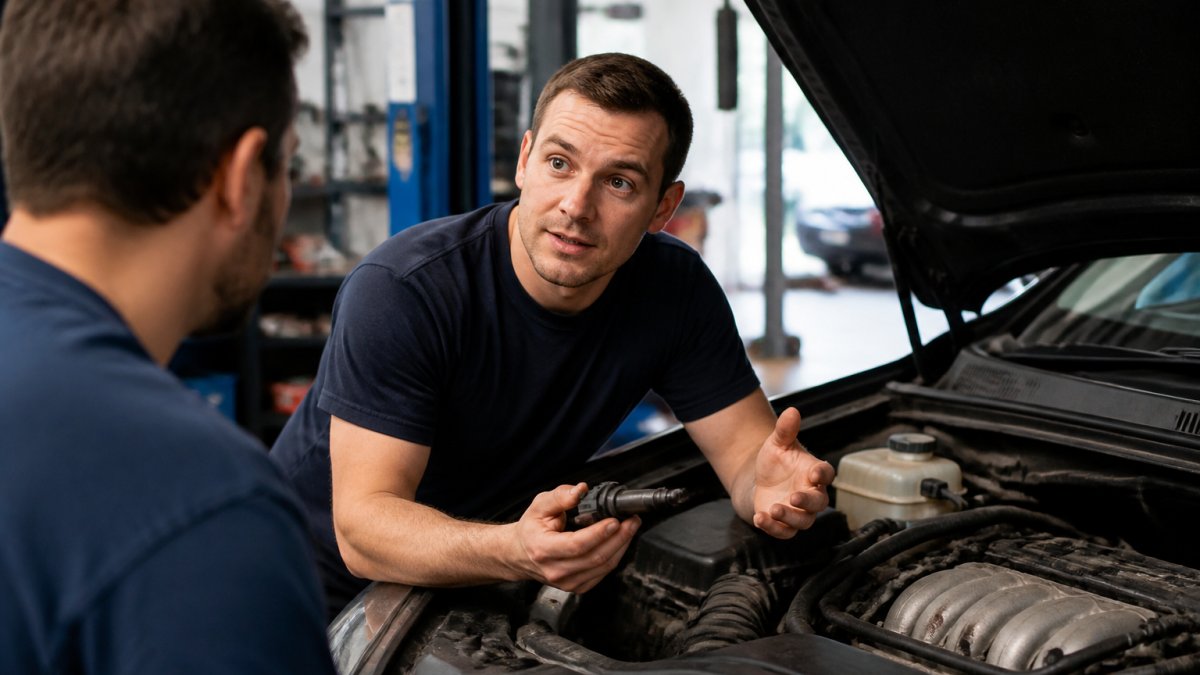
The right questions to ask a mechanic before repair turn a stressful moment into a clear conversation. Ask before you approve anything, and listen for whether the answers are specific or vague, that is the difference between a diagnosis and a sales pitch.
The core questions, and what a good answer sounds like
- "What test or symptom led you to this diagnosis?" A good answer names the test and the result, a measured value, a visual finding, or a stored code. A weak answer restates the recommendation ("your transmission needs a flush") without evidence.
- "Is this repair urgent, or can it wait?" A good answer ties urgency to a consequence: safety, further damage, or a warning light. "It can wait until your next oil change" is a valid answer, and an honest shop will give it.
- "What happens if I skip it?" This separates a safety issue from a comfort issue. Brakes and tires affect stopping; a cabin-noise fix does not.
- "Is there a cheaper option that's still safe?" Sometimes the answer is a lower part tier, a repair rather than a replacement, or a monitored wait. Ask.
- "Can I see the old parts after the work is done?" A shop that keeps your old parts is a shop that has nothing to hide. Ask them to set the parts aside.
- "Can you put the diagnosis and recommendation in writing?" This is the single most useful request you can make. A written diagnosis protects you and gives you something to compare if you seek a second opinion.
What a diagnostic trouble code can and cannot prove
Modern cars store diagnostic trouble codes (DTCs) that a scan tool reads through the OBD-II port. A code is a starting point, not a diagnosis: it tells a technician which system reported a fault, not which part failed.
Often a code points to a circuit or sensor range while the real cause is a worn connector, a vacuum leak, or a failing upstream component.
Sort the recommendation by urgency before you decide
Once you have answers, place each recommendation into one of three buckets:
- Fix now, safety-critical. Brakes, tires, steering, suspension, and anything that affects stopping or control. Delaying these is not a savings; it is a risk.
- Schedule soon, reliability. A battery nearing the end of its life, a belt showing wear, a slow fluid leak. These can usually be planned rather than done on the spot.
- Monitor or optional, comfort and cosmetic. Cabin noise, an AC recharge that is not urgent, minor trim. These can wait for budget and convenience.
If everything on the list is marked "urgent," ask why each item is urgent. Real urgency has a reason behind it, and a good advisor can give you one in a sentence.
Use the answers to decide, not just to listen
Bring the written diagnosis and your owner's manual schedule together. If a recommended service is not in your manual and not tied to a symptom you reported, ask what evidence supports it.
At JM&H Automotive Inc., our digital vehicle inspections include photo evidence of what we find. You see the worn part before you approve the repair. That's how trust gets built, and it is the standard you should expect from any shop you use.
How to Get a Second Opinion on Car Repairs Without Wasting Time
Getting a second opinion on car repairs is faster than most people think. A good shop can often confirm or challenge a diagnosis in a short visit, especially if you bring the first estimate.
Here's how to do it without losing a day:
- Call ahead and explain you want a second opinion on a written estimate.
- Bring the original estimate and any photos or notes.
- Ask for a diagnosis, not just a price match.
A second opinion isn't about distrust. It's about confirmation. Most honest shops welcome it.
The National Highway Traffic Safety Administration also tracks safety recalls by VIN. Check yours before approving any repair. A recall fix may be free.
Prioritize Repairs by Safety and Urgency to Avoid Unnecessary Car Repairs
Not all repairs are equal. Sorting them by safety and urgency is how you avoid unnecessary car repairs while keeping your vehicle safe.
Use this simple ranking:
| Priority | Examples | Action |
|---|---|---|
| Safety-critical | Brake pads, tires, steering, suspension | Fix now |
| Reliability | Battery, belts, fluid leaks | Schedule soon |
| Comfort | AC recharge, cabin noise | Fix when budget allows |
| Cosmetic | Trim, paint, minor dents | Optional |
When a shop hands you a list, sort every item into one of these buckets. If everything is marked "urgent," ask why. Real urgency has a reason behind it.
Driving Habits and Routine Checks That Prevent Costly Repairs
Your driving habits and weekly checks prevent more repairs than any additive or upsell. Small habits add up over thousands of miles.
Start with these:
- Check tire pressure monthly. Low tires wear faster and hurt fuel economy.
- Rotate tires on schedule. Even wear means longer tire life.
- Brake smoothly. Coasting before stops reduces brake-pad wear.
Ten minutes of checking each week prevents the wear and tear that leads to expensive fixes later.
Spot the Warning Signs of Over-Maintenance Before You Approve Work
Over-maintenance is real: a shop recommending services your manual doesn't list, or pushing replacements before the interval is due.
Watch for these signs:
- A service not listed in your owner's manual
- A "recommended" replacement well before the mileage interval
- Pressure to decide on the spot
None of these automatically mean something is wrong. But each one deserves a question.
Conclusion
Avoiding unnecessary car repairs comes down to three habits: know your manual, ask questions, and get things in writing.
If you want a shop that shows you the evidence before you approve anything, JM&H Automotive Inc. is built for exactly that.
Schedule an appointment with JM&H Automotive Inc. and get a clear, honest answer about what your car actually needs.
Frequently Asked Questions
How can I tell if a car repair is really necessary?
Ask the shop to show you the problem, not just describe it. A written diagnosis with photo or video evidence, the diagnostic code that triggered the recommendation, and a measurement (brake pad thickness in millimeters, for example) all back up the claim. If a shop cannot or will not document the issue, treat that repair as optional until someone else confirms it. Preventive maintenance items listed in your owner's manual are usually legitimate; add-on flushes and treatments sold at the counter deserve more scrutiny.
What questions should I ask before approving a car repair?
Ask four things: what happens if I wait, how the shop confirmed the problem, whether the part is new, remanufactured, or aftermarket, and what the total out-the-door price includes. Also ask for the repair in writing with labor and parts separated. A shop that answers these plainly is giving you the information you need to decide. Vague answers about "it's just recommended" are a signal to slow down and get a second look before you sign.
When should I get a second opinion on car repairs?
Get one when the estimate is large, when the diagnosis feels disconnected from what you're experiencing, or when a shop recommends work your owner's manual doesn't call for at your mileage. A second opinion costs far less than an unnecessary repair. Bring your written estimate and ask the second shop to inspect the same items, not to re-diagnose from scratch. If both shops agree on the diagnosis and the price range, you can approve the work with confidence.
Can I ask a mechanic to show me the problem before approving a repair?
Yes, and a transparent shop will offer this before you ask. Digital vehicle inspections with photo evidence have made it standard practice at many independent shops. Ask to see the worn part, the fluid condition, or the diagnostic screen. For safety-critical items like brakes, tires, and suspension, seeing the measurement or the worn component helps you judge urgency for yourself instead of taking a recommendation on faith.