 how-to
How to Verify Mechanic Repair Estimates
Table of Contents
- Why Verifying Repair Estimates Matters
- Step 1: Review the Written Auto Repair Estimate for Completeness
- Step 2: Verify Labor Hours and Rates Are Reasonable
- Step 3: Assess Parts Quality and Cost
- Step 4: Ask Key Questions to Ask a Mechanic About Repairs
- Step 5: Get a Second Opinion on Car Repair Before Committing
- Step 6: Understand State Requirements and Estimate Validity
- Frequently Asked Questions
Last Updated: October 19, 2026
Why Verifying Repair Estimates Matters
Many owners don't know what to look for, and some shops give vague descriptions or unexplained charges.
A complete estimate protects both you and the shop, preventing disputes when the final bill arrives. Here's how to verify mechanic repair estimates are accurate, fair, and complete.
Step 1: Review the Written Auto Repair Estimate for Completeness
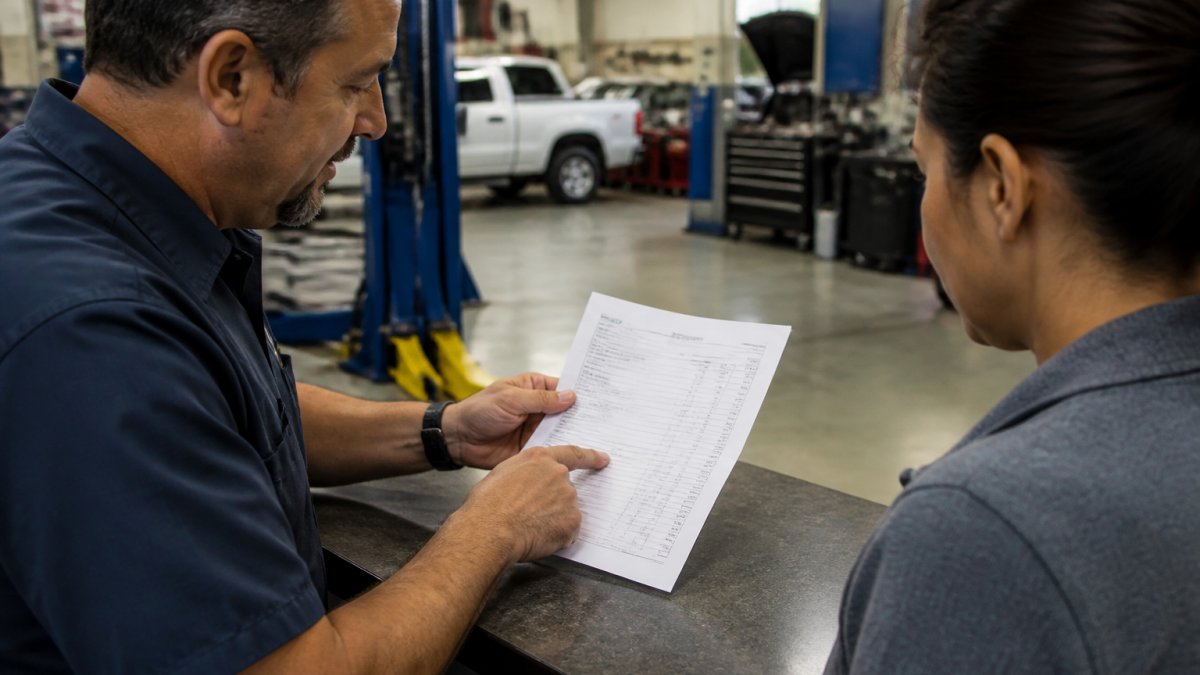
Your written auto repair estimate should read like a contract: every line tells you exactly what work is being done and why. If it doesn't, ask questions before signing.
What a complete estimate should include
A solid estimate includes these core elements:
- Vehicle identification: Year, make, model, and current mileage
- Repair description: Specific details about what's wrong and what will be fixed
- Parts list: Names and quantities of any parts that will be replaced
Red flags in poorly detailed estimates
Watch for these warning signs:
- Vague descriptions like "engine work" instead of "replace serpentine belt"
- No parts list or generic "miscellaneous parts"
- Missing labor hours or rates
If an estimate lacks detail, ask for a line-by-line breakdown. A reputable facility will provide it without hesitation.
Step 2: Verify Labor Hours and Rates Are Reasonable
Labor is typically the largest portion of your repair bill and the line item most often taken on faith. The hourly rate matters, but so does the time estimate, and the two are calculated differently.
How labor hours are actually derived
Most shops price labor using a flat-rate guide rather than a stopwatch. Third-party estimating systems publish standard hours for a specific operation on a specific vehicle, for example, replacing front brake pads and rotors on a given year, make, and model. The technician is paid for book time whether the job takes longer or shorter.
That matters for verification because:
- Book time is operation-specific. "Brake work" has no single labor time. Pad replacement, rotor replacement, caliper replacement, and brake fluid flush are separate operations with separate times. If your estimate bundles them into one vague line, you cannot verify it.
- Book time assumes a clean, rust-free vehicle. Shops commonly add time for rust, seized fasteners, or corrosion, but they should say so on the estimate, not surprise you at pickup.
- Diagnostic time is usually separate. The hour spent finding the problem is not the same as the hours spent fixing it. A complete estimate shows diagnostic charges as their own line.
How to check the hourly rate against local norms
Labor rates vary by region, shop type, and technician certification. Dealerships generally charge more per hour than independent shops; shops with manufacturer-specific certifications often sit between the two. To sanity-check a rate:
- Ask the shop for its posted hourly rate before you authorize anything. Reputable shops state it without hesitation.
- Call two or three local shops and ask their rate for the same category of work. You are looking for a range, not a single "correct" number.
- Ask whether the rate is the same for all work or whether diagnostic, electrical, and heavy-repair labor carry different rates. Many shops use a higher diagnostic rate.
A rate at the low end of the local range is not automatically better. Very low rates can signal less experienced technicians or fees added elsewhere on the invoice.
Normalizing labor hours across estimates
When you have two estimates for what sounds like the same job, compare labor lines operation by operation, not totals:
- List every labor operation on each estimate (e.g., "replace front pads," "replace front rotors," "machine rotors," "bleed brake system").
- Match operations across estimates. If one shop lists "machine rotors" and the other lists "replace rotors," those are different jobs with different labor times and different parts costs.
- Compare hours per matched operation. A gap of a few tenths of an hour is normal; a gap of an hour or more on the same operation deserves a question.
- Ask each shop whether its quoted hours are book time or an actual-time estimate, and whether any additional time is built in for rust or access.
- Check that diagnostic time is listed separately and not folded into the repair labor.
Using a repair cost estimator to validate labor time
Online estimators can cross-check book time, but they're only as good as the inputs. To use one effectively:
- Search the exact operation, not the system ("replace front brake pads and rotors," not "brakes").
- Enter the correct year, make, model, and engine, labor times can differ by powertrain.
- Compare the estimator's hours to the shop's hours for the same operation.
Estimators show averages. Your vehicle may legitimately take longer due to corrosion or previous repairs, but that extra time should be explained on the estimate, not discovered later.
Red flags specific to labor
- A single lump-sum labor charge with no operation breakdown.
- Hours that do not change between very different vehicles or engines.
- Diagnostic time buried inside a repair line.
If any of these appear, ask for a line-by-line labor breakdown before approving the work. A shop that stands behind its estimate will provide it.
Step 3: Assess Parts Quality and Cost
Parts can make up 40-60% of your repair bill. Understanding what type of parts you're getting, and whether the price is fair, matters significantly.
OEM vs. aftermarket parts: what you're getting
OEM parts are original equipment manufacturer parts, coming directly from your vehicle's maker or an authorized distributor. They fit perfectly and carry the manufacturer's warranty.
Aftermarket parts are made by third-party manufacturers.
Your estimate should specify which type you're getting. If it doesn't, ask, a good shop will explain the trade-off.
At JM&H Automotive Inc., we use professional-grade, shop-sourced parts.
Comparing parts pricing across estimates
When comparing multiple estimates for the same repair:
- Write down the exact part name and part number from each estimate
- Search that part number online to see what other shops charge
- Compare prices, but also compare the parts themselves (OEM vs. aftermarket, new vs. used)
Don't just pick the cheapest estimate. A shop that sources parts carefully and stands behind them with a warranty is worth paying slightly more.
Step 4: Ask Key Questions to Ask a Mechanic About Repairs
The questions you ask reveal how confident the shop is in their diagnosis and how transparent they'll be.
Questions that reveal diagnosis confidence
- "How did you diagnose this problem?" (A confident shop explains their process step-by-step)
- "What would happen if we don't do this repair?" (This helps you understand urgency and risk)
- "Are there other possible causes you ruled out?" (This shows they did thorough diagnostics)
A shop that answers these clearly has done real diagnostic work; one that's vague or defensive probably hasn't.
Questions about scope and necessity
- "Is this repair urgent or can it wait?" (Some repairs are safety-critical; others can be deferred)
- "What's included in this estimate and what's not?" (Clarify the exact scope)
- "Will you call me if you find additional problems during the repair?" (This protects you from surprise charges)
These questions separate shops that respect your money from shops that don't.
Step 5: Get a Second Opinion on Car Repair Before Committing
A second opinion costs time but can save you hundreds of dollars, especially for major repairs or if something feels off about the first estimate.
When a second opinion is worth the cost
Get a second opinion when:
- The repair cost exceeds a certain threshold (e.g., anything over $500)
- The repair is complex or unfamiliar to you
- The first shop recommended very expensive work
A second opinion takes 30-60 minutes and often costs little or nothing. It's cheap insurance.
How to compare estimates when repair scope differs
Sometimes two shops diagnose the same problem differently, one recommends replacing a part, another recommends repair. That's where comparing estimates gets tricky.
To compare fairly:
- Get the exact repair description from each shop in writing
- If the scopes differ, ask each shop why they chose their approach
- Ask which approach is more likely to solve the problem permanently
If two shops recommend completely different repairs, get a third opinion or ask your original shop why the second shop's approach wouldn't work, that conversation often reveals important details.
Step 6: Understand State Requirements and Estimate Validity
Estimate and authorization rules are set at the state level and vary more than most drivers expect, there is no single national overage percentage. Some states require a written estimate on request or above a dollar threshold, some require documented authorization before work begins, and some cap how far a final bill can exceed the estimate without new approval.
What to confirm about your state's rules
Before you sign an estimate, find out four things for your state:
- Whether a written estimate is required, and whether it is required only on request or automatically above a certain dollar amount.
- Whether authorization must be in writing, some states require the shop to obtain written approval before starting work or before exceeding the estimate.
- Whether there is an overage cap, some states limit how much the final bill may exceed the estimate without a new authorization; others have no fixed percentage but require customer consent for any additional work.
- Where complaints go, typically the state attorney general's consumer protection division or a state motor vehicle repair regulatory board, depending on the state.
A practical way to check: search your state attorney general's website for "auto repair" consumer guidance and your state's motor vehicle repair statute. Many states publish a plain-language guide summarizing estimate, authorization, and recordkeeping requirements.
What a valid estimate should state about itself
Regardless of state rules, a well-built estimate answers these questions on its face:
- How long is the estimate valid? Parts prices and labor rates change; an estimate with no expiration date is hard to enforce later.
- What is the scope? The operations and parts listed are what the shop is agreeing to perform. Work not listed is outside the estimate.
- What triggers a call? The estimate should state the shop's policy for contacting you if additional problems are found.
What to do when the final bill exceeds the estimate
This is the situation the estimate rules exist to prevent. Know the sequence before it happens:
- Compare the invoice to the approved estimate line by line. Identify exactly which operations or parts were added and by how much the total increased.
- Locate your authorization record. If the shop contacted you about additional work, there should be a record, a signed addendum, an emailed or texted approval, or a documented phone authorization. Ask for it.
- Ask the shop to explain the difference in writing. Request an itemized explanation of each added charge and the authorization for it.
- Raise the issue before paying if possible. Once you pay, your leverage changes. If you must pay to get the vehicle back, pay by a method that creates a record (credit card) and note on the invoice that you are disputing specific lines.
- Escalate if the shop will not adjust. File a complaint with your state attorney general's consumer protection division and, if your state has one, the motor vehicle repair regulatory board. Keep copies of the estimate, the authorization record, the final invoice, and all correspondence.
- Consider small claims court for amounts within your state's limit. The estimate, the authorization record, and the itemized invoice are the core evidence.
Estimate validity and follow-up work
An estimate is a snapshot, not a warranty that the price will never change. Legitimate reasons for a change include discovered related damage, parts price changes, or additional labor the shop could not see until disassembly.
At JM&H Automotive Inc., our digital vehicle inspections with photo evidence show exactly what we found and why, and we document approvals before additional work begins.
Frequently Asked Questions
What should I look for in a written auto repair estimate?
A complete written auto repair estimate should list the vehicle year, make, and model; describe each repair in detail; specify whether parts are OEM, aftermarket, or used; show separate labor hours and hourly rates; include diagnostic fees if applicable; and provide a total cost. The estimate should also state how long it's valid and whether additional repairs discovered during work require customer approval before proceeding.
How can I use a car repair cost estimator to verify my mechanic's quote?
Online car repair cost estimators let you enter your vehicle details, repair type, and location to see typical labor hours and parts costs in your area. Compare these estimates to your mechanic's quoted labor hours and parts prices. If your mechanic's labor hours are significantly higher than the industry standard, ask why, some repairs genuinely take longer depending on vehicle condition or complexity.
Should I get a second opinion on car repair for major work?
Yes, a second opinion is worth the diagnostic fee for repairs exceeding $500 or if you're unsure whether the work is necessary. A second shop can confirm the diagnosis and validate the scope of work. If both estimates align closely on labor hours, parts needed, and cost, you have confidence the repair is legitimate. If estimates differ significantly, investigate why before authorizing work.
What questions should I ask a mechanic about repairs before approving the work?
Ask: What is causing this problem and how did you diagnose it? Is this repair urgent or can it wait? What happens if I don't do this repair now? Are there temporary solutions? What warranty covers this work? Will you call me if you discover additional repairs during the job? These questions reveal whether the mechanic understands the issue and respects your decision-making authority.